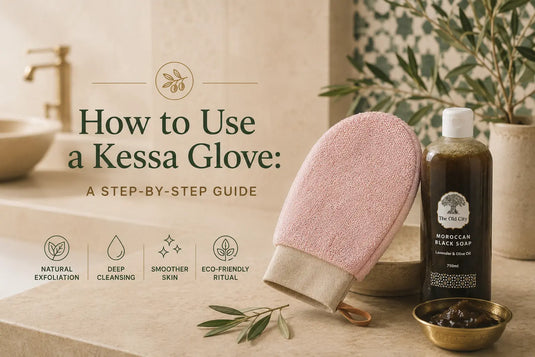
If you’ve ever stepped out of a traditional hammam and run your hand over your arm, you’ll know the feeling: skin so smooth it barely seems like your own. The secret isn’t an expensive cream or a clever gadget. It’s a humble woven mitt called a kessa — and once you know how to use it properly, it’s the most satisfying step in any shower.
The catch is that most people use a kessa wrong: too hard, on dry skin, far too often. Done right, it’s gentle, weekly, and genuinely transformative. Here’s how.
What is a kessa glove?
A kessa (also spelled kese) is a close-woven exfoliating mitt that has been used in Middle Eastern and North African bathing rituals for centuries. Unlike a plastic shower puff or a soft sponge, its slightly coarse weave is designed to do one thing well: lift away the layer of dull, dead skin that builds up on the surface. It slips over your hand like a glove, it’s reusable for months, and there’s no plastic involved.
You may have tried body scrubs with sugar or salt. A kessa works differently — it exfoliates through gentle friction rather than abrasive grains, which means no mess, no microplastic beads, and far more control over how much you take off.
Why it works so well
Your skin naturally sheds dead cells all the time, but they don’t always clear away cleanly — especially in winter, or on rougher areas like elbows, knees and the backs of your arms. That build-up is what makes skin look dull and feel uneven. A kessa simply clears it, and the results are immediate:
- Skin feels noticeably smoother to the touch.
- It looks brighter, because you’ve removed the dull surface layer.
- Moisturiser sinks in properly afterwards, instead of sitting on top of dead skin.
- Shaving and fake tan both go on more smoothly on freshly exfoliated skin.
The golden rule: soften before you scrub
This is the step everyone skips, and it’s the whole secret. Never use a kessa on dry skin. Scrubbing cold, unprepared skin is uncomfortable and far less effective — and it’s the reason so many people decide exfoliating “doesn’t work” for them.
The traditional approach softens the skin first with warmth and Moroccan black soap (beldi), a soft olive-based paste. Warm, softened skin releases its dead surface layer easily, so the kessa glides rather than drags. It’s the same method behind a proper home hammam ritual.
How to use a kessa glove, step by step
- Warm up. Spend 5–10 minutes in a warm shower or a steamy bathroom. This is what opens everything up and softens the skin.
- Apply black soap. Massage a thin layer of beldi over damp skin and leave it for 3–5 minutes. Don’t rinse it all away — a little slip helps the glove move.
- Dampen the glove. Wet the kessa so it’s damp but not dripping. A bone-dry mitt is too harsh; a soaking one loses its grip.
- Scrub in gentle, circular motions. Work over your arms, legs, back, and rougher spots like elbows and knees. Use firm but comfortable pressure — think “invigorating,” not “painful.”
- Rinse. You’ll likely see small rolls of grey, dead skin lifting away. This is completely normal — and weirdly satisfying. Rinse everything off with warm water.
- Moisturise while damp. Freshly exfoliated skin drinks up moisture, so apply a cream or light oil straight after, before you’re fully dry.
How hard should you press?
Firm enough to feel it working, gentle enough that it never hurts. A light pink flush afterwards is fine; raw, red or sore skin means you’ve gone too hard. The kessa does the work through its weave, not through force — let the mitt do the lifting and keep your pressure moderate.
How often is too often?
Once a week is the sweet spot for most people. Very rough areas can take twice a week, but daily scrubbing doesn’t give your skin time to recover and can leave it feeling sensitised. With exfoliation, gentle and regular always beats aggressive and occasional.
Where not to use it
A kessa is made for the body, not the face — facial skin is far too delicate for this kind of weave. Also avoid any skin that’s broken, irritated, sunburnt or freshly shaved. If in doubt, wait a day and let your skin settle first.
Looking after your kessa
Rinse it thoroughly after each use and hang it somewhere airy to dry out completely between sessions — the same principle that helps a bar of soap last longer keeps your mitt fresh. Over time the weave will soften and lose its grip; when it stops feeling effective, it’s time for a new one.
Common mistakes to avoid
- Using it on dry, unprepared skin (the big one).
- Scrubbing too hard in pursuit of faster results.
- Exfoliating every day instead of weekly.
- Skipping moisturiser afterwards.
- Using it on your face or on irritated skin.
Quick questions
Does using a kessa hurt? No — if it hurts, you’re pressing too hard or your skin wasn’t softened first. It should feel invigorating, not painful.
Can I use a kessa without black soap? You can use it with any gentle soap, but softening the skin first — ideally with beldi — makes a real difference to the result.
How long does a kessa last? With proper drying between uses, several months. Replace it once the weave loses its texture.
Everything you need in one set
If you’d like to try the full ritual, our 750ml Moroccan black soap comes with a kessa glove included — everything you need for a proper exfoliation session, ready to go. You’ll find more options in our hammam & exfoliation collection.
Give it one honest try, done properly, and you’ll understand why this simple mitt has survived for centuries.