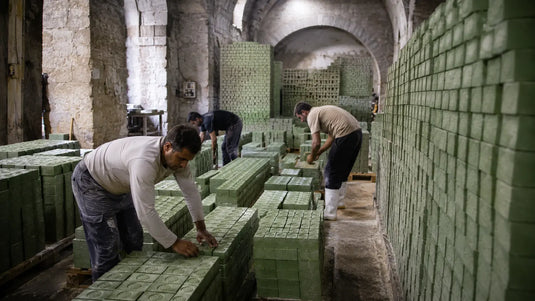
Pick up a bar of Aleppo soap and your first reaction is usually the same: this doesn’t look like soap. It’s a plain, khaki-brown block, often hand-stamped, with none of the colour or perfume you’d expect. Then you cut into it — and the inside is a deep olive green. That contrast tells you almost everything about what Aleppo soap is, and why it’s been made the same way for centuries.
Here’s what it actually is, how to spot the real thing, and how to use it.
The two-ingredient soap
Genuine Aleppo soap is made from just two oils: olive oil and laurel berry oil (from Laurus nobilis, the bay laurel tree). Add water and an alkali to turn the oils into soap, and that’s the entire recipe. No synthetic detergents, no SLS, no artificial fragrance, no colourants.
That matters more than it sounds. Most “soap” on a supermarket shelf isn’t really soap at all — it’s a synthetic detergent bar built around foaming agents and fragrance. Aleppo soap is the opposite: a true soap with a short, honest ingredient list you could read out in one breath.
- Olive oil is the base — rich in oleic acid, mild, and known for lathering softly rather than aggressively.
- Laurel oil is the signature. It’s what separates Aleppo soap from a plain olive-oil (Castile) bar, and it’s behind that distinctive earthy, woody, slightly medicinal scent. It’s also the expensive ingredient — which is why the amount of laurel in a bar tells you so much about its quality.
Why the laurel percentage matters
Not all Aleppo soap is equal, and the difference comes down to one number: how much laurel oil is in the bar.
Traditional bars range from around 5% laurel at the gentle, everyday end, up to 40% or more at the premium end. More laurel means a stronger scent, a deeper-cleansing feel, and a higher price. Lower-laurel bars are milder and a good place to start if you’ve never tried it; high-laurel bars are richer and favoured by people who want a more thorough clean. If you’re unsure, our guide to choosing the right laurel percentage breaks it down.
Made slowly, the old way
Part of what you’re paying for is time. The oils are cooked in large vats, poured out to set, then cut into blocks and stamped by hand. The bars are then stacked and left to cure — often nine months to a year, sometimes longer. During that rest, the outside oxidises to its familiar brown-khaki colour while the inside stays green. The curing is also what makes the bar so hard and long-lasting; a well-cured bar shrugs off water far better than a soft, fresh one.
How to tell if it’s the real thing
Because “Aleppo soap” sells, plenty of bars borrow the name without the recipe. Two quick checks:
- Look at the cut. Scratch or slice the surface. Real Aleppo soap is brown outside and green inside. If it’s the same colour throughout, be suspicious.
- Read the ingredients. You want olive oil and laurel oil — and not much else. A long list of names you don’t recognise is a red flag.
A short history (and why it’s everywhere now)
The soap takes its name from the Syrian city of Aleppo (Halab), where it’s been produced for a very long time — it’s widely regarded as one of the oldest soaps still made today. It’s also often credited as the ancestor of Europe’s famous hard soaps: traders and returning crusaders are said to have carried the method west, where it evolved into Castile and Marseille soap. Whether or not every detail of that journey is exact, the family resemblance is hard to miss.
What it’s good for — and what to expect
Aleppo soap is genuinely versatile: body, face, shaving, even hair. Because it’s free from synthetic fragrance and harsh detergents, it’s long been a favourite of people with sensitive skin who find heavily perfumed bars too much.
A few honest expectations so you’re not caught out:
- The lather is gentle, not foamy. True olive-oil soap gives a soft, creamy lather rather than big bubbles. That’s normal — and a good sign.
- The scent is distinctive. That earthy laurel note isn’t for everyone in a fresh bar, but it mellows as the soap ages.
- High-laurel bars clean deeply. If your skin runs very dry, a lower-laurel bar (or following with a little oil) keeps things comfortable.
It’s not a cure-all, and we’d never pretend otherwise — just a clean, traditional soap that does one job well.
Making it last
Aleppo soap rewards a little care. Keep it out of standing water on a well-draining dish and let it dry between uses — it’ll last far longer. We’ve gathered a few more tips for getting the most out of every bar if you want them.
Trying it for yourself
If you’ve read this far, you already get the appeal: a soap with nothing to hide, made the way it’s been made for generations. That’s exactly how we make ours — olive oil, laurel oil, time, and not much else. Explore our Aleppo soap collection, whether you want a single bar to test the water or a set to stock up.